The "Celiac Tax": How Much Does Being Gluten-Free Actually Cost? (And How to Save)
This post may contain affiliate links. Please read our disclosure policy.
Gluten-free bread shouldn't cost $8 a loaf. We break down the real cost of the "Celiac Tax" and give you 7 actionable ways to slash your grocery bill without sacrificing safe food.
Want to save this recipe?
Enter your email and we'll send it to you! Plus, get new recipes every week.
The Day I Paid $8 for a Tiny Loaf of Bread
The first time I went grocery shopping after my celiac diagnosis, I legitimately cried in the bakery aisle.
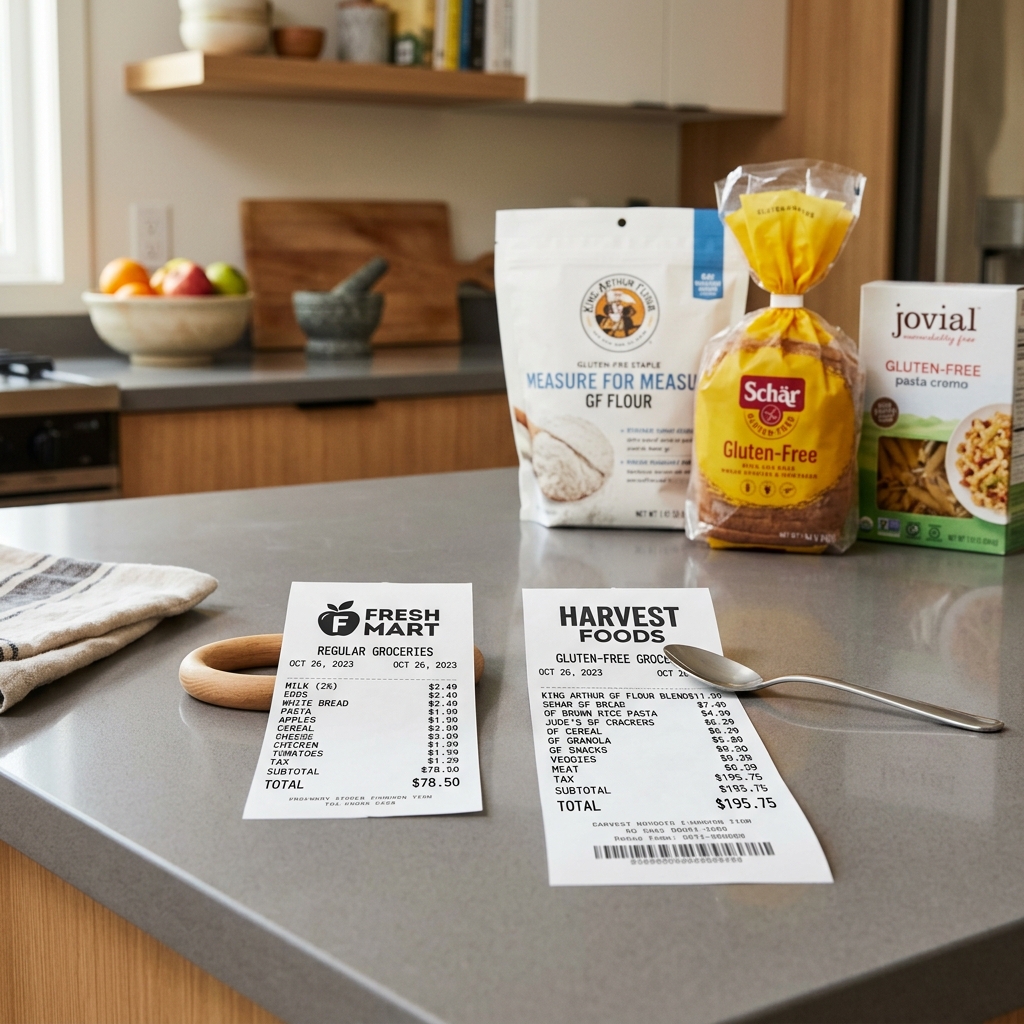
I picked up a loaf of gluten-free bread that was half the size of a normal loaf and twice the price. The sticker read $8.49. Next to it, regular wheat bread was $3.29. By the time I checked out with my GF pasta, GF crackers, and GF oatmeal, my total was nearly double what I normally spent.
Welcome to the "Celiac Tax."
It's the hidden, un-talked-about reality of a gluten-free diagnosis. You don't just have to rebuild your entire relationship with food; you have to rebuild your budget. But you're not powerless. After years of budgeting through the celiac tax, I've found that you *can* cut your grocery bill drastically without compromising your safety. Here's exactly how.
The Brutal Math: What the Celiac Tax Actually Costs
Researchers at the Celiac Disease Center at Columbia University found that gluten-free products are, on average, 183% more expensive than their wheat-based counterparts.
Let's look at the average cost breakdown (and yes, it hurts to read):
* Normal Bread: $3.50 | GF Bread: $7.50 - $9.00
* Normal Pasta (1 lb): $1.50 | GF Pasta (12 oz): $4.50
* Normal Crackers: $3.00 | GF Crackers: $6.50
* Normal Flour (5 lbs): $3.50 | GF Flour Blend (3 lbs): $12.00 - $16.00
If you rely heavily on processed gluten-free substitutes, your grocery bill can easily inflate by $1,500 to $2,500 per year per person. If you are feeding a family, that math becomes terrifying.
7 Ways to Escape the Celiac Tax
You cannot escape the fact that specialty GF items cost more. But you *can* change how you shop to minimize their impact on your wallet.
1. Shift Your Foundation to "Naturally Gluten-Free"
The quickest way to go broke is trying to replicate your old, wheat-heavy diet exactly, substitute for substitute. If you buy GF bagels for breakfast, a GF sandwich for lunch, and GF pasta for dinner, you will pay the max celiac tax.
Instead, shift your foundational carbs to things that are naturally free of gluten and naturally cheap:
* Rice: Buy large bags of Jasmine or Basmati rice. (Note: Always wash your rice and check labels for cross-contamination).
* Potatoes: Sweet potatoes, russets, and baby potatoes are incredibly cheap and filling.
* Beans and Lentils: Dry beans are some of the most cost-effective calories on the planet.
*Pro Tip:* A 10-pound bag of rice costs about $15 and will last months. A $15 budget for GF pasta will last three dinners.
2. Buy Specialty Flours Online in Bulk
If you like to bake, buying small 1-pound bags of Bob's Red Mill or King Arthur flour at the local grocery store will drain your bank account.
Instead, buy your blends in bulk. You can find large bulk packs of gluten-free flour on Amazon that significantly lower the price per ounce. Store the extra flour in an airtight container or even in the freezer to extend its shelf life.
3. Stop Buying "Gluten-Free" Certified Vegetables and Meats
Some companies charge a premium for slapping a "Gluten-Free" label on products that never contained gluten in the first place—like a bag of raw carrots or a plain chicken breast.
Unless the product has complex seasonings, marinades, or is processed on shared equipment, plain fresh produce and plain raw meats are safe. Don't pay a premium for a label on an apple.
*Need help verifying a label in the store?* We built Check Gluten for exactly this reason. Snap a photo of the ingredients before you put it in your cart, and our AI will tell you instantly if hidden gluten is lurking in that "plain" frozen chicken pack.
4. Invest in a Bread Maker
At $8 a loaf, the math on buying a bread maker works out very quickly. For the cost of 12 loaves of store-bought GF bread, you could own a highly-rated bread machine with a gluten-free setting.
Making your own bread:
5. Master the Art of the "Stretch" Meal
Instead of expensive GF pasta being the main course, use it as a side dish. Stretch expensive ingredients with cheaper veggies and proteins.
* Make soups: A single cup of GF pasta goes a long way in an overflowing pot of chicken vegetable soup.
* Make casseroles: Mix a smaller portion of GF grains with broccoli, chicken, and a homemade cheese sauce.
6. The Dedicated "GF Shelf" Strategy
If you live in a shared household (where some people eat gluten), you do *not* need to buy $7 GF crackers for the entire family.
Create a dedicated "GF Only" shelf in the pantry and the fridge. The expensive GF specialty items are *only* for the person with celiac disease. The rest of the family can eat the $3 wheat crackers. (Just ensure strict cross-contamination rules are enforced for dips, jams, and butter!)
7. Meal Planning is Your Best Defense
When you get hungry and desperate, you end up buying a $10 frozen GF pizza because you don't have a plan.
Meal planning stops you from reaching for the most expensive convenience foods. When you plan a menu around naturally GF meals (like a chicken stir-fry with rice, or a hearty beef stew with potatoes), you naturally avoid the celiac tax.
If meal planning exhausts you, check out our Ultimate Gluten-Free Bundle. It includes a massive collection of budget-friendly recipes designed specifically to keep costs low and meals delicious.
🔍 Still reading labels the hard way?
Check Gluten scans any food label in 3 seconds and tells you exactly what's safe. Trusted by celiacs worldwide.
Don't Let the Celiac Tax Break You
Having celiac disease is expensive, but it doesn't have to be financially ruinous. By shifting away from processed substitutes, buying staples in bulk, and cooking naturally GF meals, you can take back your budget.
Your health is the priority, but your peace of mind matters too.
🔍 Not sure about a product?
Check any food label instantly with our free AI gluten scanner — detects 500+ hidden gluten sources in 3 seconds.
Find Gluten-Free Guides on Amazon
Shop certified gluten-free options
Top Gluten-Free Picks
📢 Found this helpful? Share it!
Stop Guessing. Start Scanning.
Every ingredient label has hidden gluten risks. Check Gluten's AI catches them all — in 3 seconds flat.
Camera + text input
Priority support
No credit card required • Cancel anytime
The Ultimate Celiac Survival Bundle
Stop stressing over cross-contamination and what to make for dinner. Get our complete 500+ recipe cookbook, dining out guide, and label reading cheat sheets.
200+ GF Baking Recipes
& Fast Food Protocols
Instant PDF Download • 60-Day Money Back Guarantee
About the Author
Sarah Mitchell
Lead Content Writer & Nutritionist, B.S. Nutrition Science
Sarah was diagnosed with celiac disease in 2018 and writes evidence-based guides combining clinical nutrition knowledge with 6+ years of personal gluten-free living experience. All health content is medically reviewed by our advisory team.
Meet our full team →Medical Disclaimer: This article is for informational purposes only and is not a substitute for professional medical advice. Always consult your physician or a registered dietitian before making dietary changes related to celiac disease or gluten sensitivity. Read full disclaimer.
Related Articles
Best Gluten-Free Meal Delivery Services for Celiacs: 8 Services Ranked (2026)
After testing 8 meal delivery services for celiac safety, taste, and value — from dedicated GF facilities to "GF options" on shared lines — here is the honest ranking of which ones are actually safe for celiacs and which ones are not worth the risk.
The Ultimate Trader Joe's Gluten-Free Shopping Guide: 50+ Best Products (2026)
Trader Joe's is secretly one of the best grocery stores for celiacs. With clearly labeled GF products, incredible prices, and a cult following for good reason — here are the 50+ best GF finds at TJ's, organized by aisle.
Store-Bought vs Homemade GF: The Real Cost Comparison That Will Change How You Eat
We priced out 10 common gluten-free products: store-bought vs homemade. The results will make you never buy $8 GF bread again.
The Best Gluten-Free Flour Blends Compared (2026 Guide)
Stop wasting money on crumbly bakes. We tested the top 12 gluten-free flour blends to find which ones actually swap 1-to-1 with regular flour.