The 5-Minute Gluten-Free Kitchen Makeover: Erasing Cross-Contamination
This post may contain affiliate links. As an Amazon Associate, Check Gluten earns from qualifying purchases. Please read our disclosure policy.
You've stopped eating wheat, but you're still getting sick. The culprit? Your kitchen. Here's exactly what to toss, what to replace, and how to create a genuinely safe GF sanctuary in 5 minutes.
Want to save this recipe?
Enter your email and we'll send it to you! Plus, get new recipes every week.
✓Key Takeaways
"But I Didn't Eat Any Gluten!"
It's a frustrating, exhausting feeling. You’ve been perfectly compliant on your diet. You haven't touched a piece of bread, pasta, or soy sauce in weeks. Yet, you wake up bloated, your skin is breaking out, your brain fog is back, and you feel terrible.
*Where did the gluten come from?*
For newly diagnosed celiacs (and even veterans), the answer is almost always lurking right inside their own home: Cross-Contamination.
It takes just 20 parts per million (ppm) of gluten to trigger an autoimmune reaction in a celiac. That is a visual equivalent of a speck of flour the size of a pen tip. If you share a kitchen with gluten-eaters, or if you simply haven't "purged" your old equipment, your kitchen isn't safe yet.
Here is the 5-minute, ruthless kitchen makeover you need to stop getting glutened in your own home.
The "Toss It Immediately" List
Gluten proteins are incredibly sticky. They bake into porous surfaces and wedge themselves into scratches. If you used these items to cook gluten in the past, you cannot wash them clean enough. Throw them out or give them away.
📩 Want more tips like this?
Join celiacs getting weekly gluten-free tips, recipes, and hidden gluten alerts.
No spam. Unsubscribe anytime.
The "Shared Kitchen" Survival Rules
If you share a kitchen with family members who still eat regular bread and pasta, your risk of cross-contamination skyrockets. You need physical, visual boundaries.
1. The Toaster Solution
You cannot use the same toaster as a gluten-eater. The crumbs at the bottom turn to smoke when heated, and blow back onto your GF bread.
* Best Option: Buy a completely separate, cheap toaster that is in a different corner of the cabinet.
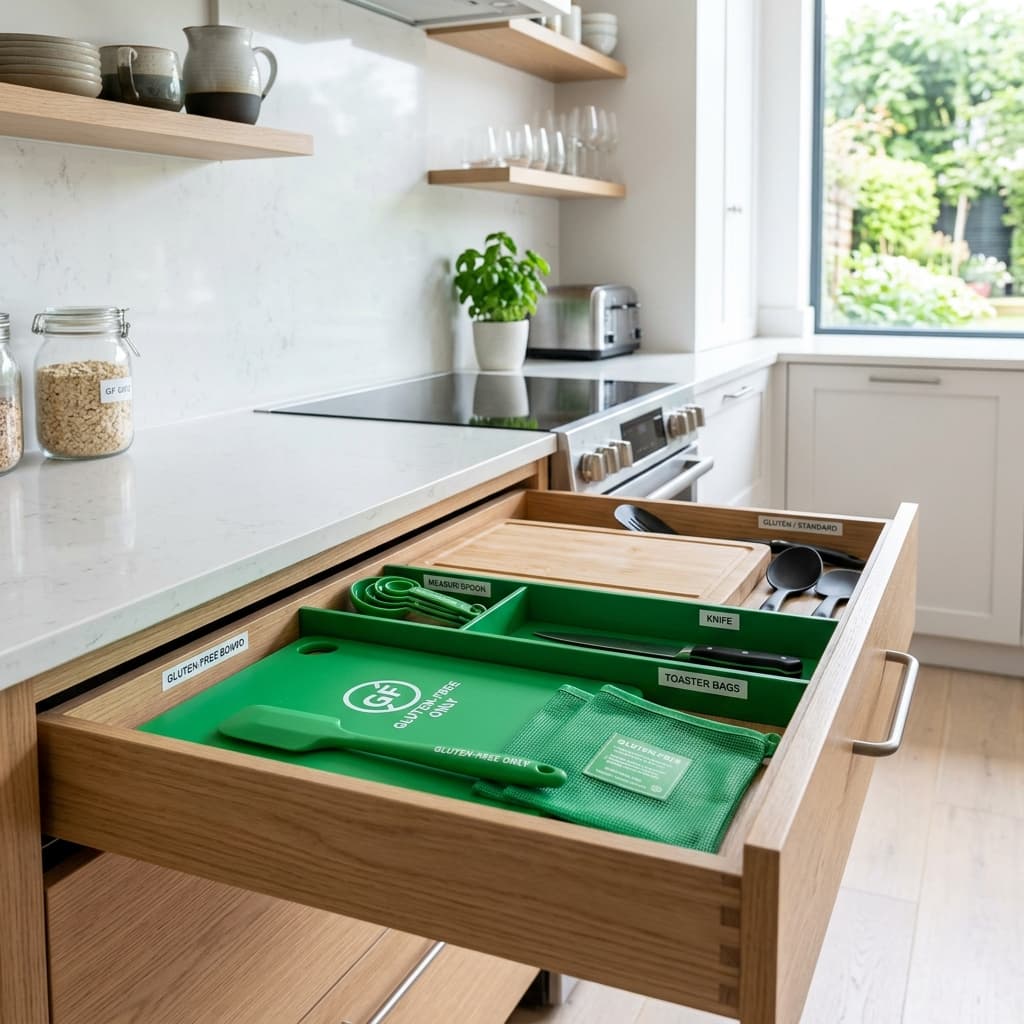
* Budget Option: Buy reusable GF Toaster Bags. You put your GF bread *in* the bag, then put the bag in the shared toaster. It cooks the bread perfectly while protecting it from the environment.
2. The Color-Coded Arsenal
Visual cues stop mistakes before they happen. Buy a set of brightly colored tools and label them YOURS.
* Buy a set of green cutting boards. Green means safe.
* Buy green silicone spatulas.
When your family sees a green tool, they know it absolutely cannot touch a wheat product.
3. The Condiment Purge
Did your partner spread mayo on wheat bread, and then double-dip the knife back into the jar? That jar of mayonnaise is now poison to you.
The solution? Squeeze bottles.
Switch all shared condiments—mayo, mustard, ketchup, jelly—to squeeze bottles. No knives go in, no crumbs come out. For butter, keep a completely separate, labeled tub of butter strictly for your GF toast.
4. The Top-Shelf Rule
Gluten falls. Gravity dictates that if a bag of regular flour is on the top shelf, flour dust will settle on the GF pasta box on the bottom shelf.
In the pantry and the fridge, GF foods *always* get the top shelf. Gluten foods go on the bottom.
The Stealth Invadors: Check Your Labels
Even after you’ve cleaned out the wooden spoons and double-dipping jars, there might be hidden gluten lurking in the foods you *thought* were safe in your fridge right now.
Are you absolutely sure about that bottle of salad dressing? What about the soy sauce alternative you bought? What about that jar of pre-made taco seasoning?
Don't wait to find out the hard way. Bring everything out onto the counter, pull up the Check Gluten app, and start taking photos of the ingredient labels. In 5 minutes, our scanner will verify every single jar, bottle, and packet in your pantry, instantly flagging anything suspicious that might be making you sick without you realizing it.
Clean your tools. Segregate your spaces. Scan your labels. Reclaim your kitchen so you can finally feel safe in your own home.
🔍 Not sure about a product?
Check any food label instantly with our free AI gluten scanner — detects 500+ hidden gluten sources in 3 seconds.
Find Gluten-Free Guides on Amazon
Shop certified gluten-free options
Top Gluten-Free Picks

Bob's Red Mill GF Flour
Essential GF pantry staple

Canyon Bakehouse GF Bread
Best-tasting GF bread

Barilla GF Pasta
Closest to regular pasta taste
As an Amazon Associate, we earn from qualifying purchases at no extra cost to you. Prices and availability are accurate as of the time of listing.
Celiac Safety Glossary
- Celiac disease
- Celiac disease is a serious autoimmune disorder in which ingesting gluten — a protein found in wheat, barley, and rye — triggers an immune response that damages the small intestine's villi, affecting approximately 1 in 100 people worldwide according to the Celiac Disease Foundation.
- Gluten
- Gluten is a family of storage proteins (prolamins and glutelins) found naturally in cereal grains like wheat (including varieties like spelt, kamut, and farro), barley, and rye, which acts as a binder to give food elasticity and shape.
- Cross-contamination
- Cross-contamination (or cross-contact) occurs when gluten-free food comes into contact with gluten-containing food or surfaces — such as shared cutting boards, toasters, fryers, or utensils — rendering otherwise safe food dangerous for people with celiac disease.
- Parts Per Million (ppm)
- Parts per million (ppm) is a unit of measurement used to quantify gluten concentration. Labeling laws in the US and Europe permit a maximum threshold of 20 ppm, while Australia requires no detectable gluten (0 ppm).
📢 Found this helpful? Share it!
Stop Guessing. Start Scanning.
Every ingredient label has hidden gluten risks. Check Gluten's AI catches them all — in 3 seconds flat.
Camera + text input
Priority support
No credit card required • Cancel anytime
The Ultimate Celiac Survival Bundle
Stop stressing over cross-contamination and what to make for dinner. Get our complete 500+ recipe cookbook, dining out guide, and label reading cheat sheets.
200+ GF Baking Recipes
& Fast Food Protocols
Instant PDF Download • 60-Day Money Back Guarantee
About the Author
Sarah Mitchell
Lead Content Writer & Nutritionist, B.S. Nutrition Science
Sarah was diagnosed with celiac disease in 2018 and writes evidence-based guides combining clinical nutrition knowledge with 6+ years of personal gluten-free living experience. All health content is medically reviewed by our advisory team.
Meet our full team →Medical Disclaimer: This article is for informational purposes only and is not a substitute for professional medical advice. Always consult your physician or a registered dietitian before making dietary changes related to celiac disease or gluten sensitivity. Read full disclaimer.
Never Miss a Hidden Gluten Alert
Join 4,200+ celiacs getting weekly tips on safe eating, hidden gluten warnings, and exclusive recipes.
Related Articles
Best Gluten-Free Beer 2026: 12 Brews Worth Drinking
Best gluten-free beers in 2026 ranked. Plus the critical truth about why "gluten-removed" beers are NOT safe for celiacs.
Best Gluten-Free Pasta 2026: Top 10 Brands That Actually Taste Good
Top 10 gluten-free pasta brands in 2026 ranked by taste, texture, and cooking performance.
Best Gluten-Free Bread 2026: We Tested 15 Brands (Honest Rankings)
The best gluten-free bread in 2026 — 15 brands ranked by taste, texture, nutrition, and price. Our honest picks.
Are Cheerios Gluten-Free? The Oat Sorting Controversy Explained
Cheerios display a prominent 'Gluten Free' label on the box, but are they safe for celiacs? Discover the mechanical oat sorting controversy, warnings from celiac organizations, and truly safe cereals.