Hidden Gluten in Medications & Supplements: A Celiac's Survival Guide (2026)
This post may contain affiliate links. As an Amazon Associate, Check Gluten earns from qualifying purchases. Please read our disclosure policy.
Your doctor prescribed a new medication, but is it gluten-free? Pharmaceutical companies are not required to clearly label gluten in prescription or over-the-counter drugs. Here's how to find hidden gluten in your medicine cabinet.
Your doctor prescribed a new medication, but is it gluten-free? Pharmaceutical companies are not required to clearly label gluten in prescription or over-the-counter drugs. Here's how to find hidden gluten in your medicine cabinet.
Want to save this recipe?
Enter your email and we'll send it to you! Plus, get new recipes every week.
✓Key Takeaways
The Prescription That Set Me Back 3 Months
Medications are one of the least obvious sources of gluten. Picture someone a year into a strict gluten-free diet, finally feeling better, who is prescribed an antibiotic.
Most drugs are gluten-free, but inactive ingredients differ between brands and generics, and wheat starch can be used as a binder.
The only way to know is to ask the pharmacist to check the specific manufacturer's product.
Here is the terrifying truth: In the United States, pharmaceutical companies are NOT required to clearly label gluten allergens on medications. The FDA regulates food labeling, but those same clear-cut rules don't fully apply to drugs.
Here's how to protect yourself and ensure your medicine cabinet is actually safe.
Where Does Gluten Hide in Medication?
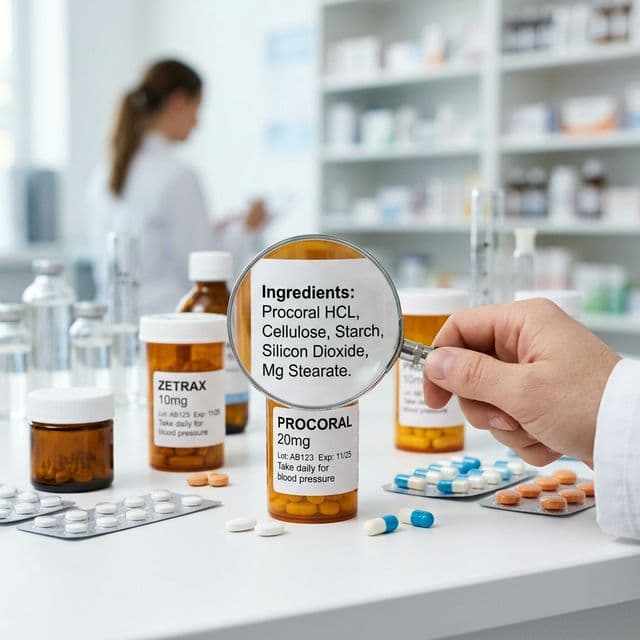
The active ingredient in a medication is almost never the problem. The issue lies in the excipients (the inactive ingredients).
Pharmaceutical companies use excipients to bind pills together, add bulk, improve absorption, or color the medication.
The most dangerous inactive ingredient is starch.
If an ingredient list simply says "starch," it could be derived from corn, potato, tapioca, OR wheat. You have no way of knowing just by looking at the label.
Red Flag Ingredients to Watch For:
*Note: In the US, if an ingredient is derived from wheat, the manufacturer is supposed to disclose it, but enforcement on generic drugs is notoriously complex and sometimes vague.*
📩 Want more tips like this?
Join celiacs getting weekly gluten-free tips, recipes, and hidden gluten alerts.
No spam. Unsubscribe anytime.
Generic Drugs vs. Name Brand
This is where it gets incredibly tricky.
Let's say your doctor prescribes Drug X. The name-brand version of Drug X is confirmed gluten-free.
However, your insurance requires you to take the generic version. There might be 5 different manufacturers making generic Drug X. Manufacturer A uses corn starch. Manufacturer B uses potato starch. Manufacturer C uses wheat starch.
Every time you refill your prescription, the pharmacy might give you pills from a different manufacturer, depending on their supplier.
Rule of Thumb: You must check the specific manufacturer EVERY SINGLE TIME you pick up a refill.
Search Amazon for gluten-free health
Amazon search results · Look for a certified gluten-free seal on the label
Gluten-Free health on Amazon

RX Bars Variety Pack
Whole-food protein, no junk
KIND Protein Bars
12g protein, certified GF
Enjoy Life Snack Bars
Free from top 14 allergens
How to Verify Your Medication is Gluten-Free
You cannot simply trust the label. You have to do the legwork. Here is the exact protocol:
Step 1: Ask the Pharmacist (But Verify)
Tell your pharmacist you have celiac disease. Ask them to look up the specific NDC (National Drug Code) number of the medication they are dispensing.
*Warning: Pharmacists are amazing, but many drug databases don't clearly state "gluten-free." They may just see "starch" and not know the source.*
Step 2: Use DailyMed
The National Institutes of Health (NIH) runs a database called DailyMed.
Step 3: Call the Manufacturer
If DailyMed is unclear, call the pharmaceutical company directly.
Ask specifically: *"Can you confirm if the excipients in this specific drug, NDC number [insert number], contain any wheat, barley, or rye derivatives, or if it is processed on shared equipment?"*
Many companies will say: *"We do not add gluten to the product, but we do not test the final product for gluten and cannot guarantee it."* (This is a standard legal liability statement. If the ingredients are naturally GF corn/potato starches, most celiacs consider it safe).
Step 4: Use Gluten-Free Medication Databases
The best resource available is GlutenFreeDrugs.com. It is maintained by a clinical pharmacist and is widely considered the gold standard for celiacs in the US. You can search by drug category to find safe name-brand and generic options.
🛒 Not sure if what you're holding is safe?
Point your phone at any ingredient label and get a clear safe / caution / unsafe answer in about three seconds — including the hidden gluten most labels bury.
Over-The-Counter (OTC) Medications
OTC medications (like Advil, Tylenol, allergy meds) are slightly easier because you can read the box, but they still carry risks.
*Always read the inactive ingredients on the back of the box before buying.*
Vitamins and Supplements
The supplement industry is notoriously under-regulated. Cross-contamination in supplement manufacturing facilities is incredibly common.
Never buy a vitamin or supplement unless it explicitly says "Gluten-Free" on the bottle.
Ideally, look for Certified Gluten-Free supplements (certified by GFCO or NSF).
Safe, Certified GF Supplement Brands:
🏆 Garden of Life — Excellent certified GF options for vitamins and probiotics.
🏆 Nature Made — Clearly labels which products are gluten-free.
🏆 SmartyPants — Great GF gummy vitamins.
🏆 MegaFood — Certified GF whole-food supplements.
🏆 Nordic Naturals — High-quality GF fish oils and omegas.
The Liquid Medication Hack
If you are prescribed an antibiotic or medication and you absolutely cannot verify the pill form, ask your doctor if it comes in a liquid suspension.
Liquid medications generally do not use starch as a binder, making them inherently less risky for hidden wheat starches. (Always verify flavorings, but they are generally safer).
Frequently Asked Questions
Can I just use a gluten-digesting enzyme (like GlutenEase) with my medication?
No. Digestive enzymes like GlutenEase do NOT protect celiacs from the immune response. They simply help break down the protein faster, but the damage to your intestines still occurs. Never use them as a shield to intentionally consume gluten.
Does the FDA regulate "gluten-free" on medications?
In 2017, the FDA issued a draft guidance encouraging drug manufacturers to clearly label gluten, but it is not legally required in the same way it is for food. This is why advocacy groups are currently fighting for the ADINA Act, which would mandate clear allergen labeling on all medications.
What if my generic drug changes shape or color?
This means the pharmacy used a different manufacturer. STOP. Do not take the pill until you verify the new manufacturer's ingredients, even if it's the "same drug."
🔍 Not sure about a product?
Photograph any food label and the AI reads every ingredient, including the 500+ names gluten hides under. Free for 14 days.
Search Amazon for gluten-free health
Amazon search results · Look for a certified gluten-free seal on the label
Gluten-Free health on Amazon
RX Bars Variety Pack
Whole-food protein, no junk
KIND Protein Bars
12g protein, certified GF
Enjoy Life Snack Bars
Free from top 14 allergens
Celiac Safety Glossary
- Celiac disease
- Celiac disease is a serious autoimmune disorder in which ingesting gluten — a protein found in wheat, barley, and rye — triggers an immune response that damages the small intestine's villi, affecting approximately 1 in 100 people worldwide according to the Celiac Disease Foundation.
- Gluten
- Gluten is a family of storage proteins (prolamins and glutelins) found naturally in cereal grains like wheat (including varieties like spelt, kamut, and farro), barley, and rye, which acts as a binder to give food elasticity and shape.
- Cross-contamination
- Cross-contamination (or cross-contact) occurs when gluten-free food comes into contact with gluten-containing food or surfaces — such as shared cutting boards, toasters, fryers, or utensils — rendering otherwise safe food dangerous for people with celiac disease.
- Gluten-free certification
- Gluten-free certification, such as the GFCO (Gluten-Free Certification Organization) seal, verifies that a product contains fewer than 10 parts per million (ppm) of gluten — stricter than the FDA's 20 ppm threshold for "gluten-free" labeling.
- Malt (Barley)
- Malt is fermented barley used as a flavoring or sweetener in cereals, chocolates, and beer; it is a major source of hidden gluten that is often overlooked on ingredient lists.
- Wheat starch
- Wheat starch is wheat flour that has had the gluten protein washed out. While some European gluten-free foods use codex-grade wheat starch (tested below 20 ppm), it can still trigger reactions in sensitive individuals.
📢 Found this helpful? Share it!
Stop Guessing. Start Scanning.
Every ingredient label has hidden gluten risks. Check Gluten's AI catches them all — in 3 seconds flat.
Camera + text input
& cross-contamination
$0 today • cancel anytime

The Essential Celiac Cookbook & Survival Bundle
Stop stressing over dinner and crumbling bread. 300+ comfort mains, 200 baking masterclass recipes, 4-week meal plans, and grocery checklists.
About This Article
Check Gluten
Written with AI assistance and checked against published sources — not by a doctor or dietitian. Confirm anything that matters with the label, the manufacturer, or your own healthcare provider.
How our content is checked →Medical Disclaimer: This article is for informational purposes only and is not a substitute for professional medical advice. Always consult your physician or a registered dietitian before making dietary changes related to celiac disease or gluten sensitivity. Read full disclaimer.
📚Sources & Citations
- •Celiac Disease Foundation — celiac.org — Comprehensive research and patient resources on celiac disease
- •Beyond Celiac — beyondceliac.org — Research-driven celiac disease advocacy and resources
- •GFCO (Gluten-Free Certification Organization) — gfco.org — Certification standards (<10 ppm)
- •FDA Gluten-Free Labeling — fda.gov — Federal regulations for <20 ppm labeling
Content reviewed and fact-checked by our clinical & nutrition team. Last updated July 2026.
Never Miss a Hidden Gluten Alert
Weekly tips on safe eating, hidden gluten warnings, and recipes — free, and one click to unsubscribe.
Related Articles
The 7 Vitamin Deficiencies Every Celiac Must Fix (And Exactly What to Take)
Celiac disease robs your body of critical nutrients — even after going gluten-free. Here are the 7 most dangerous deficiencies and the exact supplements to correct them.
Best Gluten-Free Vitamins & Supplements for Celiacs (2026)
Celiac disease causes nutrient deficiencies. Here are the best GF supplements to support recovery — iron, vitamin D, B12, and more.
Celiac Disease and Hair Loss: Why Gluten Is Making Your Hair Fall Out
Experiencing unexpected hair thinning? Discover the connection between undiagnosed celiac disease, nutrient malabsorption, and hair loss, plus the timeline for regrowth on a gluten-free diet.
Cures, Marinades and Shared Grills: Where Bacon Hides Gluten
You think bacon is just pork and salt. Think again. Here is why your weekend breakfast might be making you sick, and how to find truly celiac-safe bacon.