15 "Safe" Foods That Actually Contain Hidden Gluten (You'll Be Shocked)
This post may contain affiliate links. As an Amazon Associate, Check Gluten earns from qualifying purchases. Please read our disclosure policy.
You're eating gluten and don't even know it. These 15 everyday foods look safe but contain hidden gluten that could be causing your symptoms.
You're eating gluten and don't even know it. These 15 everyday foods look safe but contain hidden gluten that could be causing your symptoms.
Want to save this recipe?
Enter your email and we'll send it to you! Plus, get new recipes every week.
✓Key Takeaways
The Gluten Hiding In Your "Safe" Foods
You're religiously reading labels. You've cleared your kitchen. You're eating "gluten-free." But you're still getting symptoms.
Sound familiar? You're probably eating hidden gluten without realizing it.
Here are 15 foods that fool even experienced celiacs.
---
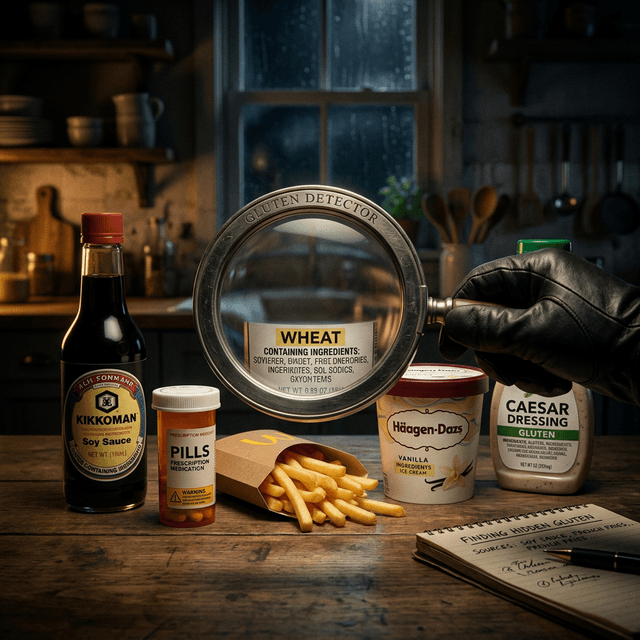
1. 🍟 French Fries
Why you think they're safe: They're literally just potatoes and oil.
The hidden gluten: Many restaurants fry them in the same fryer as breaded items (chicken tenders, onion rings, mozzarella sticks). The oil becomes contaminated. Some fries also have a wheat-based coating for extra crispiness (looking at you, Burger King).
Safe option: Fries cooked in a dedicated fryer, or make them at home.
📩 Want more tips like this?
Join celiacs getting weekly gluten-free tips, recipes, and hidden gluten alerts.
No spam. Unsubscribe anytime.
2. 💊 Medications & Supplements
Why you think they're safe: They're medicine, not food.
The hidden gluten: Many pills and capsules use wheat starch as a binder or filler. This is especially common in generic brands and store-brand supplements.
Safe option: Check with your pharmacist. Use Check Gluten to scan supplement labels.
Search Amazon for gluten-free food safety
Amazon search results · Look for a certified gluten-free seal on the label
Gluten-Free food safety on Amazon

Bob's Red Mill GF Flour
Essential GF pantry staple

Canyon Bakehouse GF Bread
Best-tasting GF bread

Barilla GF Pasta
Closest to regular pasta taste
3. 🥣 Oatmeal
Why you think it's safe: "It's just oats."
The hidden gluten: Conventional oats are grown near and processed on the same equipment as wheat, barley, and rye. Cross-contamination is almost guaranteed. One Health Canada study found about 88% of commercial oat samples contaminated above 20 ppm (Koerner et al., Health Canada, 2011).
Safe option: Only eat oats labeled "certified gluten-free" from brands like 🛒Bob's Red Mill GF OatsAmazon ↗.
🛒 Not sure if what you're holding is safe?
Point your phone at any ingredient label and get a clear safe / caution / unsafe answer in about three seconds — including the hidden gluten most labels bury.
4. 🫘 Soy Sauce
Why you think it's safe: It's a soy product.
The hidden gluten: Traditional soy sauce is made with wheat as a primary ingredient. It's roughly 50% wheat.
Safe option: Use 🛒tamariAmazon ↗ (Japanese soy sauce made without wheat) — look for GF-labeled tamari.
5. 🥗 Salad Dressings
Why you think they're safe: It's just oil and vinegar... right?
The hidden gluten: Many dressings use wheat flour or modified food starch as thickeners. Malt vinegar (from barley) is also a common ingredient.
Safe option: Make your own (olive oil + lemon + Dijon + salt) or verify packaged brands with Check Gluten.
6. 🍲 Canned Soup
Why you think it's safe: It looks like just vegetables and broth.
The hidden gluten: Most canned soups use wheat flour as a thickener — even "healthy" looking ones. Cream soups are the worst offenders.
Safe option: Progresso has some GF-labeled options. Or make soup from scratch (it's easy and cheap).
7. 🍕 Communion Wafers
Why you think they're safe: Why would a church wafer have gluten?
The hidden gluten: Traditional communion wafers are made from wheat flour. The Catholic Church has historically required wheat-based wafers.
Safe option: Many churches now offer GF communion wafers. Ask your clergy.
8. 🧴 Lip Balm & Lipstick
Why you think it's safe: You don't eat it.
The hidden gluten: You actually *do* — studies show the average person ingests 4+ pounds of lip product in their lifetime. Many lip balms contain wheat germ oil or vitamin E derived from wheat.
Safe option: Use certified GF lip products.
9. 🧁 Frosting
Why you think it's safe: Sugar, butter, and vanilla — what could go wrong?
The hidden gluten: Some store-bought frostings contain modified food starch (wheat-derived) or are processed on shared equipment.
Safe option: Make your own (butter + powdered sugar + vanilla = done) or check labels carefully.
10. 🥃 Beer
Why some think it's safe: "It's just a drink."
The hidden gluten: Beer is brewed from barley, a gluten grain. Regular beer is NOT safe for celiacs. Even "low-gluten" beers may not be safe enough.
Safe option: Dedicated GF beers (made from sorghum, rice, or millet), cider, wine, or spirits (most distilled spirits are GF).
11. 🫕 Gravy
Why you think it's safe: It's just meat drippings and seasonings.
The hidden gluten: Almost all gravy — homemade and store-bought — uses wheat flour as a thickener.
Safe option: Thicken with cornstarch or 🛒arrowroot powderAmazon ↗ instead. 🛒GF flourAmazon ↗ also works.
12. 🎨 Play-Doh
Why you think it's safe: Kids don't eat it (theoretically).
The hidden gluten: Play-Doh's main ingredient is wheat flour. Kids with celiac can get symptoms from handling it even without eating it.
Safe option: GF modeling clay or homemade play-doh with rice flour.
13. 🍺 Malt Vinegar
Why you think it's safe: Vinegar is GF.
The hidden gluten: Most vinegars *are* GF (white, apple cider, balsamic). But malt vinegar is made from barley and contains gluten. Common on fish & chips.
Safe option: Use apple cider vinegar or white vinegar instead.
14. 🥘 Marinades & Teriyaki Sauce
Why you think they're safe: It's just seasoning.
The hidden gluten: Teriyaki sauce contains soy sauce (= wheat). Many bottled marinades use soy sauce, malt, or wheat-based thickeners.
Safe option: Make marinades from scratch or look for GF-labeled versions.
15. 🍰 Ice Cream
Why you think it's safe: It's milk, sugar, and cream.
The hidden gluten: Plain flavors are usually fine. But anything with cookie dough, brownies, pie crust, cake batter, or cookie pieces contains wheat. Some brands also use wheat-based stabilizers.
Safe option: Stick to simple flavors (vanilla, chocolate, strawberry) and check labels. Check Gluten makes this instant.
---
The Only Way to Be Sure
You can't memorize every hidden gluten source. Labels change. Recipes reformulate. Cross-contamination happens.
That's why Check Gluten's AI Scanner exists — snap any label, get an instant result. No guessing. No Googling. No anxiety.
---
Ready to Cook Safely?
Our Cookbook Bundle has 500+ recipes that are ALL verified gluten-free AND dairy-free. No hidden ingredients, no surprises. Just delicious food you can trust. Only $12.
🔍 Not sure about a product?
Photograph any food label and the AI reads every ingredient, including the 500+ names gluten hides under. Free for 14 days.
Search Amazon for gluten-free food safety
Amazon search results · Look for a certified gluten-free seal on the label
Gluten-Free food safety on Amazon
Bob's Red Mill GF Flour
Essential GF pantry staple
Canyon Bakehouse GF Bread
Best-tasting GF bread
Barilla GF Pasta
Closest to regular pasta taste
Celiac Safety Glossary
- Celiac disease
- Celiac disease is a serious autoimmune disorder in which ingesting gluten — a protein found in wheat, barley, and rye — triggers an immune response that damages the small intestine's villi, affecting approximately 1 in 100 people worldwide according to the Celiac Disease Foundation.
- Gluten
- Gluten is a family of storage proteins (prolamins and glutelins) found naturally in cereal grains like wheat (including varieties like spelt, kamut, and farro), barley, and rye, which acts as a binder to give food elasticity and shape.
- Cross-contamination
- Cross-contamination (or cross-contact) occurs when gluten-free food comes into contact with gluten-containing food or surfaces — such as shared cutting boards, toasters, fryers, or utensils — rendering otherwise safe food dangerous for people with celiac disease.
- Gluten-free certification
- Gluten-free certification, such as the GFCO (Gluten-Free Certification Organization) seal, verifies that a product contains fewer than 10 parts per million (ppm) of gluten — stricter than the FDA's 20 ppm threshold for "gluten-free" labeling.
- Parts Per Million (ppm)
- Parts per million (ppm) is a unit of measurement used to quantify gluten concentration. Labeling laws in the US and Europe permit a maximum threshold of 20 ppm, while Australia requires no detectable gluten (0 ppm).
- Avenin (Oats)
- Avenin is a protein found in oats that is structurally similar to gluten. While most celiacs can tolerate pure, uncontaminated oats, a small percentage of celiacs react to avenin itself.
- Malt (Barley)
- Malt is fermented barley used as a flavoring or sweetener in cereals, chocolates, and beer; it is a major source of hidden gluten that is often overlooked on ingredient lists.
- Wheat starch
- Wheat starch is wheat flour that has had the gluten protein washed out. While some European gluten-free foods use codex-grade wheat starch (tested below 20 ppm), it can still trigger reactions in sensitive individuals.
📢 Found this helpful? Share it!
Stop Guessing. Start Scanning.
Every ingredient label has hidden gluten risks. Check Gluten's AI catches them all — in 3 seconds flat.
Camera + text input
& cross-contamination
$0 today • cancel anytime

The Essential Celiac Cookbook & Survival Bundle
Stop stressing over dinner and crumbling bread. 300+ comfort mains, 200 baking masterclass recipes, 4-week meal plans, and grocery checklists.
About This Article
Check Gluten
Written with AI assistance and checked against published sources — not by a doctor or dietitian. Confirm anything that matters with the label, the manufacturer, or your own healthcare provider.
How our content is checked →Medical Disclaimer: This article is for informational purposes only and is not a substitute for professional medical advice. Always consult your physician or a registered dietitian before making dietary changes related to celiac disease or gluten sensitivity. Read full disclaimer.
📚Sources & Citations
- •Celiac Disease Foundation — celiac.org — Comprehensive research and patient resources on celiac disease
- •Beyond Celiac — beyondceliac.org — Research-driven celiac disease advocacy and resources
- •GFCO (Gluten-Free Certification Organization) — gfco.org — Certification standards (<10 ppm)
- •FDA Gluten-Free Labeling — fda.gov — Federal regulations for <20 ppm labeling
Content reviewed and fact-checked by our clinical & nutrition team. Last updated July 2026.
Never Miss a Hidden Gluten Alert
Weekly tips on safe eating, hidden gluten warnings, and recipes — free, and one click to unsubscribe.
Related Articles
Hidden Gluten in Restaurant Food: What to Watch For (2026 Guide)
Eating out with celiac disease or gluten sensitivity? Learn where hidden gluten lurks in restaurant food and how to order safely at any restaurant.
Is Ice Cream Gluten-Free? Every Major Brand & Flavor Checked (2026)
Plain vanilla? Probably safe. Cookie dough? Definitely not. But what about that seasonal caramel swirl you're eyeing? Here is how to tell, brand by brand.
10 Everyday Foods That Secretly Contain Gluten (Number 7 Will Shock You)
You ditched bread and pasta. But these 10 sneaky foods are still glutening you. Soy sauce, deli meat, and even your vitamins might be the culprit.
How to Check if Food Is Gluten-Free: 3 Easy Methods (2026)
Learn the 3 best methods to check if food contains gluten — from reading labels to using AI scanning apps. Essential guide for celiac disease and gluten sensitivity.