Shared Fryers: Why Plain Fries Still Aren't Safe
This post may contain affiliate links. As an Amazon Associate, Check Gluten earns from qualifying purchases. Please read our disclosure policy.
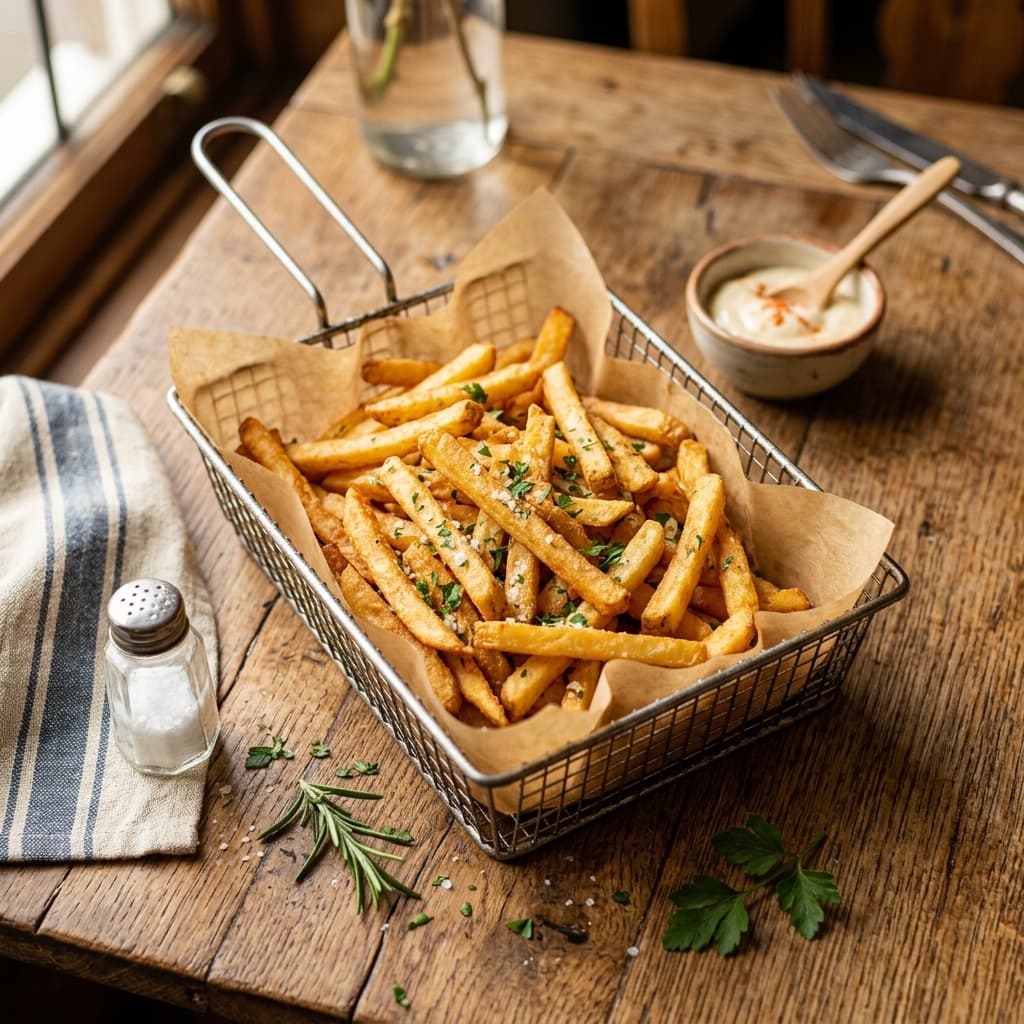
French fries are made from potatoes, so they should be naturally gluten-free. But for celiacs, ordering fries at a restaurant is one of the most dangerous things you can do.
French fries are made from potatoes, so they should be naturally gluten-free. But for celiacs, ordering fries at a restaurant is one of the most dangerous things you can do.
Want to save this recipe?
Enter your email and we'll send it to you! Plus, get new recipes every week.
✓Key Takeaways
Ordering a plain burger without the bun and a side of fries looks like the safest "hack" at any restaurant. Potatoes are naturally gluten-free, right?
Often, they are the problem. Here is why.
If you have celiac disease, you must understand that the biggest danger in a restaurant kitchen isn't the bread—it's the deep fryer. Here is everything you need to know about navigating french fries, the shared fryer nightmare, and how to eat crispy fries safely.
The Core Problem: The Shared Deep Fryer ❌
The issue is rarely the potatoes themselves. The issue is the hot oil they are cooked in.
In most restaurants and fast-food chains, the kitchen uses shared fryers. This means the exact same vat of oil used to cook your french fries is also used to fry:
* Chicken nuggets and chicken tenders (breaded in wheat flour)
* Onion rings (battered in wheat flour)
* Mozzarella sticks (coated in wheat crumbs)
* Fried fish (beer-battered)
When wheat-breaded items are dropped into hot oil, tiny crumbs and particles of gluten break off and float in the vat. When your "gluten-free" french fries are dropped into that same oil five minutes later, they absorb those gluten particles.
This is extreme cross-contamination. For a person with celiac disease, eating fries from a shared fryer is identical to eating a piece of regular bread.
Are Fast Food Fries Safe?
Let's look at the major fast-food chains. Almost all of them fail the celiac safety test.
* McDonald's: ❌ Not safe in the US. McDonald's US literally uses a "natural beef flavoring" that contains *wheat and milk derivatives* directly on the fries before they are even shipped to the store. Furthermore, they are cooked in shared fryers. (Note: McDonald's fries in Canada and Europe are often safe, but always verify locally).
* Burger King: ❌ Not safe. Shared fryers with onion rings and chicken.
* Wendy's: ❌ Not safe. Shared fryers with chicken nuggets.
* Chick-fil-A: ✅ / ⚠️ Usually Safe. Chick-fil-A is one of the rare exceptions. They cook their waffle fries in a dedicated fryer using canola oil, while their breaded chicken is cooked in a separate pressure cooker using peanut oil. However, always confirm with the manager that they haven't filtered the oils together.
* Five Guys: ✅ Safe. Five Guys only fries one thing in their stores: french fries. There are no onion rings or chicken nuggets on the menu. Their fries are cooked in 100% peanut oil in dedicated fryers.
* In-N-Out: ✅ Safe. Like Five Guys, In-N-Out only fries potatoes. Their fryers are dedicated and safe for celiacs.
📩 Want more tips like this?
Join celiacs getting weekly gluten-free tips, recipes, and hidden gluten alerts.
No spam. Unsubscribe anytime.
The Hidden Coating Trap
Even if you find a restaurant with a dedicated fryer (a fryer used *only* for french fries), you are still not completely safe.
Many restaurants buy frozen, pre-cut french fries from massive food distributors (like Sysco). To make the fries extra crispy and golden brown, manufacturers will coat them in a light dusting of flour or a wheat-based batter before freezing them.
* Seasoned Fries: Curly fries, waffle fries, and "seasoned" wedges are notorious for this. The seasoning blend almost always contains wheat flour to help the spices stick to the potato.
* The Solution: You must ask the server two questions: *"Do you have a dedicated fryer that is ONLY used for french fries?"* AND *"Are the french fries coated in any flour or wheat seasoning before frying?"*
Search Amazon for gluten-free food safety
Amazon search results · Look for a certified gluten-free seal on the label
Gluten-Free food safety on Amazon

Bob's Red Mill GF Flour
Essential GF pantry staple

Canyon Bakehouse GF Bread
Best-tasting GF bread

Barilla GF Pasta
Closest to regular pasta taste
How to Eat Fries Safely at Home
The absolute safest way to enjoy crispy french fries without the anxiety is to make them yourself.
1. The Air Fryer Revolution
If you don't have an air fryer yet, it will change your celiac life. You can get that deep-fried crunch without the massive vat of oil.
However, if you live in a shared household, you CANNOT share an air fryer with gluten-eaters. The fan circulates gluten crumbs everywhere. You need a dedicated gluten-free air fryer. The 🛒Ninja Air FryerAmazon ↗ and the 🛒Cosori Air FryerAmazon ↗ are incredible for getting perfect, crispy fries.
2. Safe Frozen Brands
When buying frozen fries at the grocery store, always look for the "Gluten-Free" label.
* Ore-Ida: Most Ore-Ida fries (Golden Crinkles, Golden Fries, Tater Tots) are proudly labeled gluten-free.
* Alexia: Many Alexia products (like their Sweet Potato Fries) are certified gluten-free, but always check the back of the bag as some of their seasoned items are not.
* McCain: McCain labels their safe products clearly, but read carefully.
🍽️ Eating out and unsure what to ask?
Scan a menu item or label and get the exact questions to ask your server about sourcing and shared equipment — no awkward guesswork.
The Verdict
Ordering french fries at a restaurant is a massive gamble. Unless you are at Five Guys, In-N-Out, or a fully dedicated gluten-free facility, you must interrogate the staff about shared fryers and hidden coatings.
When in doubt, skip the fries and order a baked potato. Or better yet, go home, fire up your 🛒dedicated GF air fryerAmazon ↗, and enjoy a massive plate of safe, crispy fries without the 3-day stomach ache.
🔍 Not sure about a product?
Photograph any food label and the AI reads every ingredient, including the 500+ names gluten hides under. Free for 14 days.
Search Amazon for gluten-free food safety
Amazon search results · Look for a certified gluten-free seal on the label
Gluten-Free food safety on Amazon
Bob's Red Mill GF Flour
Essential GF pantry staple
Canyon Bakehouse GF Bread
Best-tasting GF bread
Barilla GF Pasta
Closest to regular pasta taste
Celiac Safety Glossary
- Celiac disease
- Celiac disease is a serious autoimmune disorder in which ingesting gluten — a protein found in wheat, barley, and rye — triggers an immune response that damages the small intestine's villi, affecting approximately 1 in 100 people worldwide according to the Celiac Disease Foundation.
- Gluten
- Gluten is a family of storage proteins (prolamins and glutelins) found naturally in cereal grains like wheat (including varieties like spelt, kamut, and farro), barley, and rye, which acts as a binder to give food elasticity and shape.
- Cross-contamination
- Cross-contamination (or cross-contact) occurs when gluten-free food comes into contact with gluten-containing food or surfaces — such as shared cutting boards, toasters, fryers, or utensils — rendering otherwise safe food dangerous for people with celiac disease.
- Gluten-free certification
- Gluten-free certification, such as the GFCO (Gluten-Free Certification Organization) seal, verifies that a product contains fewer than 10 parts per million (ppm) of gluten — stricter than the FDA's 20 ppm threshold for "gluten-free" labeling.
📢 Found this helpful? Share it!
Stop Guessing. Start Scanning.
Every ingredient label has hidden gluten risks. Check Gluten's AI catches them all — in 3 seconds flat.
Camera + text input
& cross-contamination
$0 today • cancel anytime

The Essential Celiac Cookbook & Survival Bundle
Stop stressing over dinner and crumbling bread. 300+ comfort mains, 200 baking masterclass recipes, 4-week meal plans, and grocery checklists.
About This Article
Check Gluten
Written with AI assistance and checked against published sources — not by a doctor or dietitian. Confirm anything that matters with the label, the manufacturer, or your own healthcare provider.
How our content is checked →Medical Disclaimer: This article is for informational purposes only and is not a substitute for professional medical advice. Always consult your physician or a registered dietitian before making dietary changes related to celiac disease or gluten sensitivity. Read full disclaimer.
📚Sources & Citations
- •Celiac Disease Foundation — celiac.org — Comprehensive research and patient resources on celiac disease
- •Beyond Celiac — beyondceliac.org — Research-driven celiac disease advocacy and resources
- •GFCO (Gluten-Free Certification Organization) — gfco.org — Certification standards (<10 ppm)
- •FDA Gluten-Free Labeling — fda.gov — Federal regulations for <20 ppm labeling
Content reviewed and fact-checked by our clinical & nutrition team. Last updated July 2026.
Never Miss a Hidden Gluten Alert
Weekly tips on safe eating, hidden gluten warnings, and recipes — free, and one click to unsubscribe.
Related Articles
Gluten-Free at McDonald's: Every Safe Menu Item for Celiacs (2026)
McDonald's does NOT have a gluten-free menu. But there ARE items you can safely eat with celiac disease — if you know exactly what to order and what to avoid.
Gluten-Free Fast Food: What's Actually Safe at the Drive-Thru? (2026)
Are McDonald's fries gluten-free? Can celiacs eat at Chick-fil-A? The drive-thru is a minefield of shared fryers and cross-contamination. Here is the ultimate guide to ordering safe, gluten-free fast food in the US.
Are McDonald's Fries Gluten-Free in 2026? The Shocking Truth
Think McDonald's fries are safe for celiacs? In the US, the answer is a resounding NO. Discover why they contain hidden wheat and what safe alternatives exist.
Can Celiacs Eat at McDonald's? Safe Menu Guide (2026)
McDonald's doesn't have a gluten-free menu, but there ARE safe options. Here's exactly what to order and what to avoid.