The Celiac's Guide to BBQ Cross-Contamination: Grills, Smoke & Cookout Safety
This post may contain affiliate links. As an Amazon Associate, Check Gluten earns from qualifying purchases. Please read our disclosure policy.
Why high heat does NOT kill gluten, how shared grill grates contaminate food, and how to safely navigate outdoor barbecues with celiac disease.
Why high heat does NOT kill gluten, how shared grill grates contaminate food, and how to safely navigate outdoor barbecues with celiac disease.
Want to save this recipe?
Enter your email and we'll send it to you! Plus, get new recipes every week.
✓Key Takeaways
No, high grill heat does not destroy or neutralize gluten, making shared barbecue grates one of the highest-risk cross-contamination hazards for people with celiac disease. Gluten is a stable structural protein complex (gliadin and glutenin) that only chars into carbonized residue rather than safely denaturing at standard cooking temperatures (300°F to 600°F). Ingesting microscopic particles transferring from previously cooked wheat buns, malt glazes, or shared grill tools is sufficient to trigger small intestinal villous atrophy in celiac patients.
---
The Myth of "Burning Off" Gluten on Shared Grills
One of the most dangerous myths about shared grills is the belief that cranking the heat for ten minutes "burns away" any leftover gluten.
To understand why this is medically false, we must look at the biochemistry of proteins versus microorganisms:
According to clinical studies validated by the Celiac Disease Foundation, ingesting as little as 10 milligrams of gluten (equivalent to 1/64th of a teaspoon of flour, or 20 parts per million in food) causes quantifiable mucosal inflammation and immune activation in patients with celiac disease.
---
4 Primary BBQ Contamination Vectors
When attending a cookout or operating a multi-diet outdoor kitchen, cross-contact happens through four distinct pathways:
```
CROSS-CONTAMINATION AT THE GRILL
┌───────────────────────────────────────────────────────────┐
│ 1. Direct Grate Transfer: Baked-on wheat marinades & buns │
│ 2. Tool Transfer: Spatulas flipping wheat & GF burgers │
│ 3. Airborne Char & Ash: Flying particles in windy areas │
│ 4. Condiment Double-Dipping: Basting brushes & squeeze bottles │
└───────────────────────────────────────────────────────────┘
```
1. Shared Cooking Grates
Placing a certified gluten-free burger patty directly onto grill iron where a regular wheat hamburger bun was toasted minutes prior guarantees direct transfer of hundreds of parts per million of gluten.
2. Shared Utensils & Spatulas
A pitmaster uses a wide metal spatula to press a conventional cheeseburger, wiping molten wheat bun crumbs across the blade, then uses the same spatula to flip your plain chicken breast.
3. Basting Brushes & Sauce Bowls
A basting brush swept across regular pork ribs absorbs gluten from commercial marinades, is dipped back into the shared sauce pot, and then slathered across gluten-free poultry.
4. Seasoning & Wood Pellet Fillers
Commercial barbecue rubs frequently utilize unlisted wheat flour as an anti-caking agent. Furthermore, low-grade wood pellets manufactured for automated smokers occasionally incorporate grain-based vegetable oil lubricants or industrial starch binders during pellet extrusion.
---
📩 Want more tips like this?
Join celiacs getting weekly gluten-free tips, recipes, and hidden gluten alerts.
No spam. Unsubscribe anytime.
Safe BBQ Equipment & Strategy Comparison
---
Search Amazon for gluten-free bbq
Amazon search results · Look for a certified gluten-free seal on the label
Gluten-Free bbq on Amazon

Primal Kitchen BBQ Sauce
Gluten-free labeled, no added sugar

G Hughes Sugar Free BBQ Sauce
Gluten-free labeled, sugar free

San-J Organic Tamari
Swap for soy sauce in marinades
How to Decontaminate a Shared or Pre-Owned Grill
If you share a household grill with non-celiac family members or purchased a seasoned barbecue smoker second-hand, a cursory wire brush scrub is insufficient.
True decontamination requires thorough mechanical stripping of all organic carbon and grease layers:
When restoring high-end barbecue pits, the pitmasters at Flame and Feast have documented safe methods for deep cleaning seasoned grill grates and balancing thermal airflow so you can strip baked-on organic buildup without compromising the underlying metal integrity.
---
🍞 Tired of GF food that tastes like cardboard?
500+ gluten-free recipes, a baking masterclass and 4 weeks of meal plans — instant PDF download.
5 Essential Rules for Attending Cookouts with Celiac Disease
Attending a summer cookout should be a joyful social experience, not a source of medical anxiety. Follow these five practical rules:
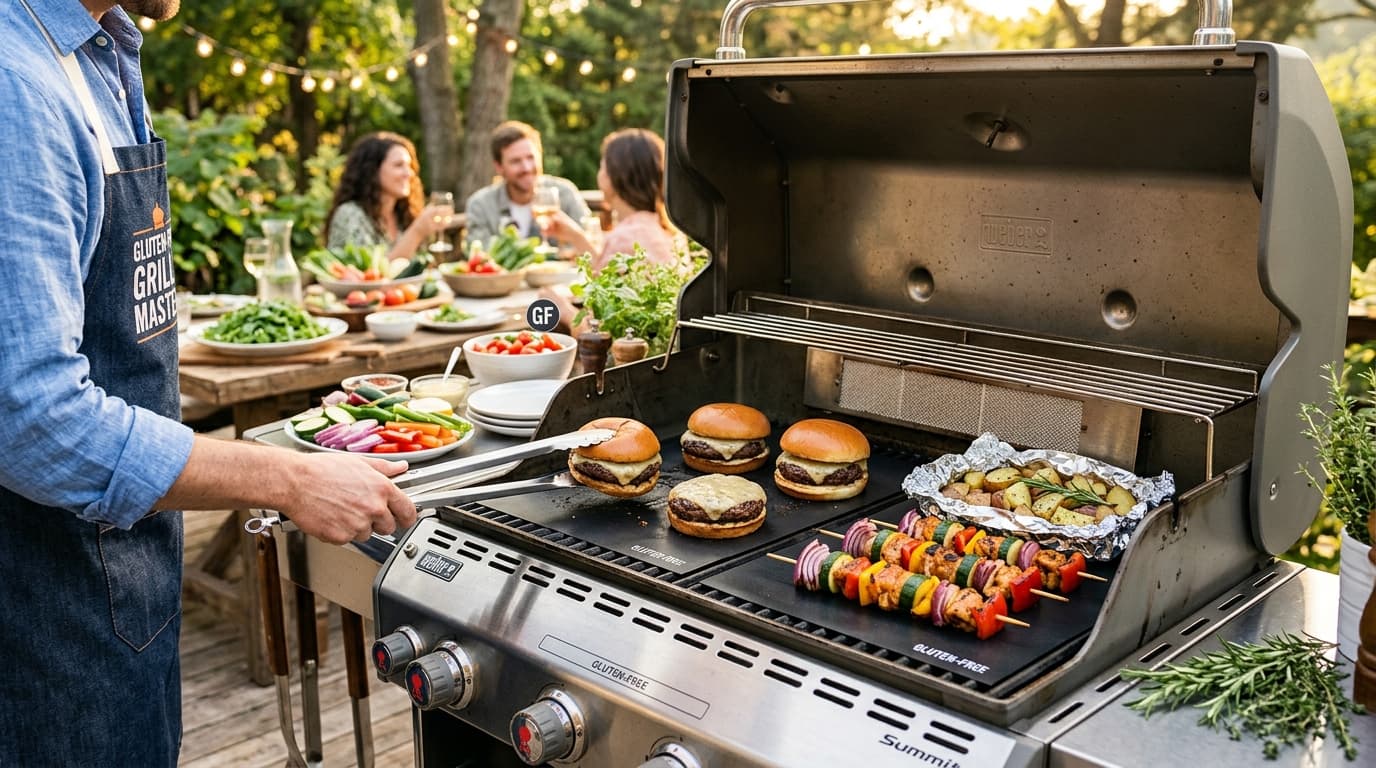
1. Bring Your Own Physical Barrier
Pack a roll of 🛒Heavy Duty Aluminum FoilAmazon ↗ or reusable 🛒Non-Stick Grill MatsAmazon ↗. Ask the host to place your mat on the upper warming rack or a dedicated side burner.
2. Bring Dedicated Tongs & Spatula
Keep a bright red, color-coded 🛒heat-resistant silicone spatula and tongs setAmazon ↗ in your bag. Hand them to the cook and politely explain: *"Could you please use these clean tongs just for my food?"*
3. Cook Gluten-Free Meats First
Request that the host grill certified gluten-free burgers and meats at the very beginning of the party, before regular wheat buns, beer-can chicken, or flour-thickened barbecue glazes are placed on the grates.
4. Bring Your Own Certified Buns & Condiments
Do not use open condiment bottles or community squeeze bottles that have touched wheat bread. Bring your favorite 🛒gluten-free hamburger bunsAmazon ↗ and individual condiment packets.
5. Verify Rubs and Wood Pellets
Ensure seasonings are certified gluten-free and specify that raw hardwoods (like post oak or hickory) contain zero additive binders. For comprehensive fuel comparisons, read our companion analysis on certified gluten-free ingredients and cross-contact verification standards.
---
Frequently Asked Questions
Can charcoal smoke carry gluten into food?
Pure hardwood lump charcoal and clean split logs produce pure combustion gases and aromatics (guaiacol and syringol) which are naturally gluten-free. However, if charcoal briquettes use wheat-based starch as an extrusion binder (rare in premium brands but possible in budget options) or if the smoker has caked-on wheat marinade inside the smoke stack, heavy swirling convective drafts can theoretically dislodge particulate matter. Stick to 100% natural hardwood lump charcoal or pure hardwood pellets.
Are wood pellets for pellet smokers gluten-free?
Premium wood pellet brands (like Bear Mountain, Lumber Jack, and Traeger) use 100% virgin hardwood pressurized with natural tree lignins—they do not use wheat starch binders. Always verify that pellet packaging states 100% hardwood with no added chemical binders.
Is barbecue sauce naturally gluten-free?
No. Many commercial barbecue sauces use soy sauce (brewed with wheat), malt vinegar (derived from barley), or modified food starches made from wheat. Always look for third-party certified gluten-free labeling on barbecue sauces.
What should I do if my food accidentally touches a dirty grill grate?
Do not attempt to scrape off the char or wash the cooked meat under water. The heat and rendered fat will have already transferred microscopic gluten proteins into the meat fibers. Discard the contaminated portion and cook a fresh piece on a clean aluminum foil barrier.
🔍 Not sure about a product?
Photograph any food label and the AI reads every ingredient, including the 500+ names gluten hides under. Free for 14 days.
Search Amazon for gluten-free bbq
Amazon search results · Look for a certified gluten-free seal on the label
Gluten-Free bbq on Amazon
Primal Kitchen BBQ Sauce
Gluten-free labeled, no added sugar
G Hughes Sugar Free BBQ Sauce
Gluten-free labeled, sugar free
San-J Organic Tamari
Swap for soy sauce in marinades
Celiac Safety Glossary
- Celiac disease
- Celiac disease is a serious autoimmune disorder in which ingesting gluten — a protein found in wheat, barley, and rye — triggers an immune response that damages the small intestine's villi, affecting approximately 1 in 100 people worldwide according to the Celiac Disease Foundation.
- Gluten
- Gluten is a family of storage proteins (prolamins and glutelins) found naturally in cereal grains like wheat (including varieties like spelt, kamut, and farro), barley, and rye, which acts as a binder to give food elasticity and shape.
- Cross-contamination
- Cross-contamination (or cross-contact) occurs when gluten-free food comes into contact with gluten-containing food or surfaces — such as shared cutting boards, toasters, fryers, or utensils — rendering otherwise safe food dangerous for people with celiac disease.
- Gluten-free certification
- Gluten-free certification, such as the GFCO (Gluten-Free Certification Organization) seal, verifies that a product contains fewer than 10 parts per million (ppm) of gluten — stricter than the FDA's 20 ppm threshold for "gluten-free" labeling.
- Malt (Barley)
- Malt is fermented barley used as a flavoring or sweetener in cereals, chocolates, and beer; it is a major source of hidden gluten that is often overlooked on ingredient lists.
- Wheat starch
- Wheat starch is wheat flour that has had the gluten protein washed out. While some European gluten-free foods use codex-grade wheat starch (tested below 20 ppm), it can still trigger reactions in sensitive individuals.
📢 Found this helpful? Share it!
Stop Guessing. Start Scanning.
Every ingredient label has hidden gluten risks. Check Gluten's AI catches them all — in 3 seconds flat.
Camera + text input
& cross-contamination
$0 today • cancel anytime

The Essential Celiac Cookbook & Survival Bundle
Stop stressing over dinner and crumbling bread. 300+ comfort mains, 200 baking masterclass recipes, 4-week meal plans, and grocery checklists.
About This Article
Check Gluten
Written with AI assistance and checked against published sources — not by a doctor or dietitian. Confirm anything that matters with the label, the manufacturer, or your own healthcare provider.
How our content is checked →Medical Disclaimer: This article is for informational purposes only and is not a substitute for professional medical advice. Always consult your physician or a registered dietitian before making dietary changes related to celiac disease or gluten sensitivity. Read full disclaimer.
📚Sources & Citations
- •Celiac Disease Foundation — celiac.org — Comprehensive research and patient resources on celiac disease
- •Beyond Celiac — beyondceliac.org — Research-driven celiac disease advocacy and resources
- •GFCO (Gluten-Free Certification Organization) — gfco.org — Certification standards (<10 ppm)
- •FDA Gluten-Free Labeling — fda.gov — Federal regulations for <20 ppm labeling
Content reviewed and fact-checked by our clinical & nutrition team. Last updated July 2026.
Never Miss a Hidden Gluten Alert
Weekly tips on safe eating, hidden gluten warnings, and recipes — free, and one click to unsubscribe.
Related Articles
Gluten-Free BBQ: The Sauces, Marinades and Grill Traps to Watch
The meat is usually fine. It's the sauce, the marinade and the grill itself that get people. A practical guide to a cookout you can actually eat at.
15 "Safe" Foods That Actually Contain Hidden Gluten (You'll Be Shocked)
You're eating gluten and don't even know it. These 15 everyday foods look safe but contain hidden gluten that could be causing your symptoms.
Hidden Gluten in Restaurant Food: What to Watch For (2026 Guide)
Eating out with celiac disease or gluten sensitivity? Learn where hidden gluten lurks in restaurant food and how to order safely at any restaurant.
Celiac at a Party: How to Survive Potlucks, BBQs, Holidays & House Parties Without Getting Sick (Or Missing Out)
The host says "don't worry, I made something gluten-free!" You smile and quietly wonder if they used the same cutting board, the same serving spoon, the same oven that had bread in it 20 minutes ago. Here's the complete party survival playbook.