Celiac Gut Healing: The 12 Best Foods to Repair Your Intestines After Diagnosis
This post may contain affiliate links. As an Amazon Associate, Check Gluten earns from qualifying purchases. Please read our disclosure policy.
Your doctor said "go gluten-free" but didn't mention the 12 foods that actually speed gut healing. After 18 months of research and working with a celiac-specialized dietitian, here's the recovery meal plan nobody gives you.
Your doctor said "go gluten-free" but didn't mention the 12 foods that actually speed gut healing. After 18 months of research and working with a celiac-specialized dietitian, here's the recovery meal plan nobody gives you.
Want to save this recipe?
Enter your email and we'll send it to you! Plus, get new recipes every week.
✓Key Takeaways
"Go Gluten-Free and Come Back in 6 Months"
That's what my gastroenterologist said after diagnosing me with celiac disease. Go gluten-free. Come back in 6 months. That was the ENTIRE treatment plan.
No guidance on what TO eat. No mention of foods that accelerate healing. No supplement recommendations. No discussion of the nutritional deficiencies that 60-80% of newly diagnosed celiacs have. Just... "go gluten-free."
I did go gluten-free. And for the first 3 months, I still felt terrible. Bloating. Fatigue. Brain fog. Joint pain. I was doing everything "right" — zero gluten — but my body wasn't recovering as fast as I'd hoped.
Then I found a celiac-specialized dietitian who changed everything. She didn't just tell me what to AVOID. She told me what to EAT. Specific foods that provide the raw materials your intestinal lining needs to rebuild itself.
Within 4 weeks of following her protocol, the bloating reduced by 80%. Within 3 months, my brain fog was gone. My follow-up biopsy at 12 months showed near-complete villous recovery.
Here are the 12 healing foods she recommended — and the science behind each one.
Understanding What's Broken
When you have active celiac disease, your immune system is destroying the villi — tiny finger-like projections in your small intestine that absorb nutrients. Think of them as the shag carpet of your gut. Celiac flattens that carpet into smooth tile.
When you go GF, the immune attack stops. But your intestine still needs to REBUILD those villi. That takes raw materials: specific amino acids, anti-inflammatory compounds, and gut-friendly bacteria.
The 12 foods below provide those raw materials.
📩 Want more tips like this?
Join celiacs getting weekly gluten-free tips, recipes, and hidden gluten alerts.
No spam. Unsubscribe anytime.
The 12 Best Gut Healing Foods for Celiacs
1. Bone Broth 🏆 (The #1 Healing Food)
Why it works: 🛒Bone brothAmazon ↗ is rich in glutamine, glycine, proline, and collagen — the four amino acids your intestinal lining needs most to rebuild. It's also incredibly gentle on a damaged gut.
How to use it:
Make your own: Roasted chicken bones + water + apple cider vinegar + onion + carrots + celery. Simmer 12-24 hours in a 🛒slow cookerAmazon ↗. The vinegar helps extract minerals from the bones.
2. Collagen Peptides
Why it works: 🛒Collagen peptidesAmazon ↗ provide concentrated glycine and proline — building blocks for intestinal tissue. Studies show these amino acids help seal the "leaky gut" that celiac creates.
How to use it: Add 1-2 scoops daily to coffee, smoothies, or oatmeal (certified GF oats). 🛒Vital ProteinsAmazon ↗ is my pick — unflavored, certified GF, dissolves completely.
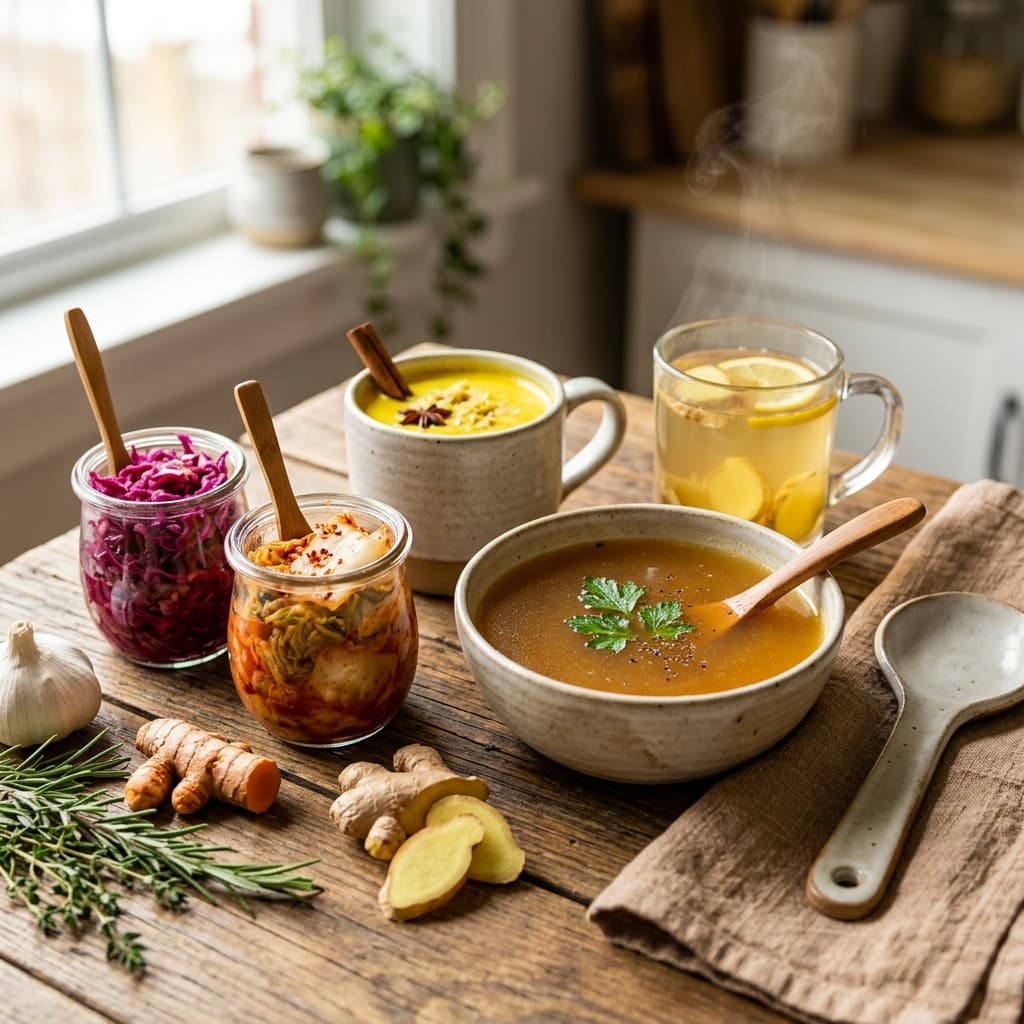
3. Fermented Foods (Probiotics)
Why it works: Your gut microbiome is disrupted by celiac disease. Fermented foods introduce beneficial bacteria that help rebuild a healthy gut ecosystem.
Best options:
Important: Start SMALL with fermented foods. A damaged gut may not tolerate large amounts initially. Begin with 1-2 tablespoons and increase over weeks.
4. Wild-Caught Salmon & Fatty Fish
Why it works: Omega-3 fatty acids are powerful anti-inflammatories. Celiac disease is fundamentally an inflammatory condition. Omega-3s reduce intestinal inflammation and support tissue repair.
How to use it: Eat fatty fish 2-3 times per week. Best options: wild salmon, sardines, mackerel, herring. Can't eat enough fish? Add a 🛒fish oil supplementAmazon ↗ (Nordic Naturals is certified GF).
5. Ginger & Turmeric
Why they work: Both are potent anti-inflammatories. Turmeric's curcumin has been studied specifically for intestinal inflammation. Ginger soothes nausea and aids digestion — common issues during celiac recovery.
How to use them:
6. Sweet Potatoes
Why they work: Rich in vitamin A (beta-carotene), which is essential for intestinal cell turnover and mucosal repair. Many celiacs are deficient in vitamin A due to malabsorption. Sweet potatoes are also gentle on the gut and packed with fiber for feeding beneficial gut bacteria.
How to use them: Bake whole, mash with butter, roast cubes, or add to soups. Eat with a fat source (butter, olive oil) to increase vitamin A absorption.
7. Bananas (Especially Slightly Green)
Why they work: Slightly underripe bananas contain resistant starch — a prebiotic that feeds beneficial gut bacteria. Ripe bananas are gentle, easy to digest, and provide potassium (often depleted in celiacs with diarrhea).
8. Eggs
Why they work: Eggs are one of the most nutrient-dense foods on earth. They provide high-quality protein, choline (for cell membrane repair), vitamin D, B12, and selenium — all commonly deficient in celiacs. Plus they're gentle on the stomach and infinitely versatile.
9. Avocados
Why they work: Healthy monounsaturated fats, fiber, and glutathione — an antioxidant that supports intestinal healing. Also provide folate and vitamin K.
10. Pumpkin & Winter Squash
Why they work: Rich in vitamin A, fiber, and anti-inflammatory compounds. The soluble fiber is especially gentle on recovering guts. 🛒Butternut squash soupAmazon ↗ is an ideal recovery food.
11. L-Glutamine Supplement
Why it works: L-glutamine is THE primary fuel source for intestinal cells (enterocytes). Studies show it helps repair intestinal permeability ("leaky gut"). Many celiac dietitians recommend 5-10g daily during the first year of recovery.
Best option: 🛒NOW L-Glutamine PowderAmazon ↗ — certified GF, unflavored, mixes into any liquid.
12. Probiotic Supplement
Why it works: A targeted 🛒probioticAmazon ↗ can accelerate microbiome recovery. Look for strains studied in celiac:
Best picks: 🛒CulturelleAmazon ↗ (GF, contains LGG), 🛒AlignAmazon ↗ (GF, Bifidobacterium), 🛒FlorastorAmazon ↗ (GF, S. boulardii).
Shop Verified Gluten-Free health
Amazon PrimeDirect links to certified <10-20 ppm brands · Skip the label-squinting
Top-Rated Gluten-Free health

RX Bars Variety Pack
Whole-food protein, no junk
KIND Protein Bars
12g protein, certified GF
Enjoy Life Snack Bars
Free from top 14 allergens
The Week-by-Week Gut Healing Plan
Weeks 1-2: Gentle Introduction
Weeks 3-4: Building Up
Month 2-3: Expanding
Month 4-6: Maintaining
🛒 Not sure if what you're holding is safe?
Point your phone at any ingredient label and get a clear safe / caution / unsafe answer in about three seconds — including the hidden gluten most labels bury.
Frequently Asked Questions
How long does celiac gut healing take?
Most celiacs see symptom improvement within 2-4 weeks. Intestinal healing (confirmed by biopsy) takes 6-24 months in adults. Children typically heal faster (3-6 months). Complete villous recovery depends on severity of damage, age, and how strictly gluten is avoided.
Can I speed up gut healing?
Yes — that's what this guide is about. A strict GF diet alone will heal your gut, but adding these healing foods provides the raw materials for faster repair. Bone broth, collagen, probiotics, and anti-inflammatory foods are all supported by research.
Should I take a multivitamin after celiac diagnosis?
Most celiac dietitians recommend it. Common deficiencies at diagnosis include iron, calcium, vitamin D, B12, folate, and zinc. 🛒Thorne Basic NutrientsAmazon ↗ is a popular certified GF option. Get blood work done to identify YOUR specific deficiencies.
Is bone broth really that important?
Many celiac recovery protocols consider it foundational. The amino acid profile (glutamine, glycine, proline, collagen) directly supports intestinal lining repair. Is it a magic cure? No. Is it one of the most nutrient-dense, gut-supportive foods you can consume? Absolutely.
Why do I still feel sick even though I'm 100% GF?
Several possibilities: (1) Hidden gluten exposure — use Check Gluten to audit your diet. (2) Your gut hasn't healed yet — it takes months. (3) Secondary lactose intolerance (common until villi recover). (4) Other food intolerances developed during active celiac. (5) Nutrient deficiencies. Discuss with your gastroenterologist and consider seeing a celiac-specialized dietitian.
🔍 Not sure about a product?
Photograph any food label and the AI reads every ingredient, including the 500+ names gluten hides under. Free for 14 days.
Shop Verified Gluten-Free health
Amazon PrimeDirect links to certified <10-20 ppm brands · Skip the label-squinting
Top-Rated Gluten-Free health
RX Bars Variety Pack
Whole-food protein, no junk
KIND Protein Bars
12g protein, certified GF
Enjoy Life Snack Bars
Free from top 14 allergens
Celiac Safety Glossary
- Celiac disease
- Celiac disease is a serious autoimmune disorder in which ingesting gluten — a protein found in wheat, barley, and rye — triggers an immune response that damages the small intestine's villi, affecting approximately 1 in 100 people worldwide according to the Celiac Disease Foundation.
- Gluten
- Gluten is a family of storage proteins (prolamins and glutelins) found naturally in cereal grains like wheat (including varieties like spelt, kamut, and farro), barley, and rye, which acts as a binder to give food elasticity and shape.
- Gluten-free certification
- Gluten-free certification, such as the GFCO (Gluten-Free Certification Organization) seal, verifies that a product contains fewer than 10 parts per million (ppm) of gluten — stricter than the FDA's 20 ppm threshold for "gluten-free" labeling.
- Avenin (Oats)
- Avenin is a protein found in oats that is structurally similar to gluten. While most celiacs can tolerate pure, uncontaminated oats, a small percentage of celiacs react to avenin itself.
- Malt (Barley)
- Malt is fermented barley used as a flavoring or sweetener in cereals, chocolates, and beer; it is a major source of hidden gluten that is often overlooked on ingredient lists.
📢 Found this helpful? Share it!
Stop Guessing. Start Scanning.
Every ingredient label has hidden gluten risks. Check Gluten's AI catches them all — in 3 seconds flat.
Camera + text input
& cross-contamination
$0 today • cancel anytime

The Essential Celiac Cookbook & Survival Bundle
Stop stressing over dinner and crumbling bread. 300+ comfort mains, 200 baking masterclass recipes, 4-week meal plans, and grocery checklists.
About the Author
Sarah Mitchell
Lead Content Writer & Nutritionist, B.S. Nutrition Science
Sarah was diagnosed with celiac disease in 2018 and writes evidence-based guides combining clinical nutrition knowledge with 6+ years of personal gluten-free living experience. All health content is medically reviewed by our advisory team.
Meet our full team →Medical Disclaimer: This article is for informational purposes only and is not a substitute for professional medical advice. Always consult your physician or a registered dietitian before making dietary changes related to celiac disease or gluten sensitivity. Read full disclaimer.
📚Sources & Citations
- •Celiac Disease Foundation — celiac.org — Comprehensive research and patient resources on celiac disease
- •Beyond Celiac — beyondceliac.org — Research-driven celiac disease advocacy and resources
- •GFCO (Gluten-Free Certification Organization) — gfco.org — Certification standards (<10 ppm)
- •FDA Gluten-Free Labeling — fda.gov — Federal regulations for <20 ppm labeling
Content reviewed and fact-checked by our clinical & nutrition team. Last updated July 2026.
Never Miss a Hidden Gluten Alert
Weekly tips on safe eating, hidden gluten warnings, and recipes — free, and one click to unsubscribe.
Related Articles
Celiac Disease and Weight Gain: Why You're Gaining Weight on a Gluten-Free Diet
Gaining unexpected weight after starting a gluten-free diet? Discover why healing gut villi absorb more calories, the trap of processed GF foods, and how to maintain a healthy weight.
The 5 Best Gluten-Free Probiotics for Celiac Gut Healing
Going gluten-free stops the damage, but it doesn't automatically heal your gut. These are the top certified gluten-free probiotics designed to restore your microbiome.
Celiac Disease and Fatigue: Why You're Still Tired on a Gluten-Free Diet
Strictly gluten-free but still completely exhausted? Learn why celiac disease causes chronic fatigue, how long gut healing takes, and the exact steps to reclaim your energy.
Celiac Disease and Weight: Why You Gained (or Lost) Weight After Diagnosis (2026)
Many people expect to lose weight on a gluten-free diet, but for celiacs, the opposite often happens. Here is the science behind "celiac weight gain," how villous atrophy affects your metabolism, and how to stabilize your weight during recovery.